
FOOT-TO-COM
NARROW
A narrow foot-to-center of mass (COM) happens when the feet land very close to, or even across, the midline. Excessive “cross-over” gait creates a longer lever arm which leads to increased demand on the hip abductors and IT band.
Generally, the structures on the outside of the leg will have to work harder to keep the runner upright which can lead to lateral knee pain, IT band pain, strain of the lateral ankle or lateral calf muscles, and excessive chaffing.
COMMON CAUSES OF A NARROW FOOT-TO-COM:
Tight hip adductors
Weakness of the hip abductors (gluteus medius and minimus) —> results in an inability to “hold” the leg out in a neutral track causing adduction during the swing phase and ultimately a foot strike that is too close to the center
EXERCISES
Side Plank with Top Hip Abduction
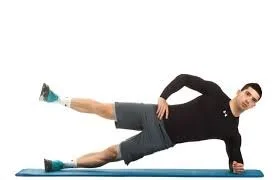
Start in a side plank position.
Focus on keeping your shoulders, hips and ankles all in a straight line → don’t let your shoulders roll forward.
Holding the position, lift and lower your top leg.
Make sure you keep your bottom hip up the whole time.
Add a band around your knees or ankles to make this more challenging
Side Stepping
Start with the band around your ankles and in a small squat position
Take 20 steps to the right and then 20 steps to the left
Focus on leading with your heel. Do not let your toes turn out; this will activate the hip flexor instead of the lateral hip stabilizers (glute med and glute min) which are the target muscles of this exercise
Stay in the small squat position the whole time. Imagine you have a pencil on your forehead and “draw” a straight line as you are stepping, rather than an up-and-down line
Single Leg RDL (Romanian Dead Lift)
Standing on one leg, hinge forward until your body is parallel to the ground and then stand back up
Keep your non-standing leg inline with the rest of your body; imagine your upper body and non-standing leg are a board
Don’t let the hip of your non-standing leg rotate up; keep your hips level while you hinge forward
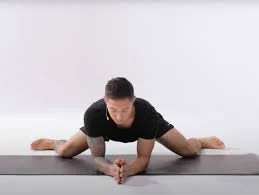
Adductor Stretch
Rock back and forth to find the stretch that is deepest and works best for where your tightness is
WIDE
With a wide foot-to-COM the foot is striking the ground significantly lateral to the body’s midline and the runner might look like they are running on skiis.
This gait pattern can cause an increase in compressive forces to the medial knee, a loss of energy into the lateral movement, and excessive lateral foot loading which can lead to potential bone stress injuries to the 5th metatarsal of the foot and strain of the lateral lower leg muscles.
COMMON CAUSES OF A WIDE FOOT-TO-COM:
Compensation for general instability
Protective Guarding
EXERCISES
In general, for this gait pattern you want to address the root of the instability issues by working on your balance and footwork. Things like agility ladder work, and single-leg exercises such as Romanian Dead Lifts and Bulgarian Split Squats will help with stability. If you have this gait pattern due to protective guarding, addressing the “why” and “what” you are guarding from will be important.
Single Leg Romanian Dead Lift
Standing on one leg, hinge forward until your body is parallel to the ground and then stand back up
Keep your non-standing leg inline with the rest of your body; imagine your upper body and non-standing leg are a board
Don’t let the hip of your non-standing leg rotate up; keep your hips level while you hinge forward
Bulgarian Split Squat
SETUP: Start sitting at the edge of a bench/box/couch. Extend one foot forward to obtain the right distance from the seat to where your foot should be placed for the exercise. Maintain the position of the foot and roll forward onto your front foot and stand up. From here, place the back foot up on the bench you were sitting on.
Keep your upper body upright and drive your back knee down towards the ground to perform the exercise.
You should focus on driving the back knee DOWN as opposed to your front knee forward.