
KNEE FLEXION
LACK OF FLEXION
A lack of knee flexion at initial contact of the gait pattern is when the knee is too straight or “locked out” when the foot is initially contacting the ground.
Generally, a lack of knee flexion will cause the transmission of the ground reaction forces (GRF) directly into the hips and low back as opposed to being absorbed partially by the quadriceps. This increased GRF into the hips and low back can lead to bone stress injuries, low back pain, and/or hip issues.
COMMON CAUSES OF LACK OF KNEE FLEXION:
Low cadence
Purposefully braking to try to avoid impact
Overactive quadriceps compared to hamstrings/excessive quad strength in comparison to the hamstring strength
Lacking sufficient hip extension/poor hip mobility
EXERCISES
See “Heel-to-COM” page for information on cadence work.
Hamstring Bridges
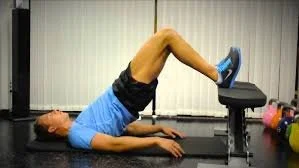
Lie on your back with your heels propped up on a bench/chair
Your knees and hips should each be as close to a 90-degree angle as possible
Dig your heels into the bench and hold
While holding the “dig” lift your hips up into the bridge position and then lower back down
The main focus of this exercise is to engage your hamstrings; you do this by putting the focus into pushing your heels into the bench and maintaining that contraction
Nordic Hamstring Curls
Start with your heels hooked under something sturdy/your partner holding your heels
SLOWLY lean forward to engage your hamstrings and lean as far forward as you can without "breaking" your hips --> keep from bending at your hips
Once you get to just before your “break point”, pause and then return to the starting position slowly and with control.
You CAN use your hands to help you lower and return as needed so you can get a larger range of motion without losing good form
Nordic Stick - device that allows you to do this exercise more easily at home
Hip Flexor Stretch & Activation
Start at the edge of the table/bed with ½ your butt cheeks hanging off the end and then lean back and pull both knees to chest.
Hold one knee securely to your chest and then lower the other leg down to feel a stretch in front of your hip.
Focus on keeping your low back plastered to the table/bed by holding your knee firmly to your chest and engaging your lower abdominal muscles (muscles between your pubic bone and your belly button).
After stretching for 20 seconds, then perform 10 lift-and-lowers and then switch legs
Really focus on engaging your lower abdominal muscles by using the cue: pubic bone to belly button
***Add 5lb ankle weights to increase the stretch and lift and lower
NORMAL FLEXION
We want 10-20 degrees of knee flexion at the initial contact phase of the gait cycle. This allows for a “compliant” landing; the lower extremity can act like a “spring” rather than a rigid “pillar” and will the muscles will more appropriately absorb the ground reaction forces (GFR). Lower GRFs protect the knee joint, reduce likelihood of developing bone stress injuries, and improve overall efficiency.
COMMON REASONS WHY A RUNNER WILL HAVE A NORMAL AMOUNT OF KNEE FLEXION:
Higher/”appropriate” cadence —> this will bring the foot’s landing point closer to the COM
Midfoot/Forefoot strike
Good eccentric quad control