
KNEE JOINT CENTER ALIGNMENT
LATERAL
A runner with a lateral knee joint center alignment likely has the “bow legged” look; the knee joint is wide to the hip-to-ankle axis.
Generally, a lateral knee joint center alignment increases wear and tear on the medial knee structures such as the medial meniscus and increases tension through the ITB.
COMMON CAUSES OF A LATERAL KNEE JOINT CENTER ALIGNMENT:
Skeletal structure of the person
High/supinated arches
Very short ITB
The goal is to improve the “compliance” of the limb and to encourage the knee to track more neutrally toward the midline and to strengthen the inner thigh muscles to encourage a pull back towards midline.
EXERCISES
Copenhagen - Lift&Lower Leg
Start in a side plank position with your top leg bent and propped up on a chair or bench
Lift up into the full side plank position by pushing into your top knee using your adductors
Lift and lower your bottom leg up to meet the top leg and then back down
Make sure your ankle and knee are lifting and lowering at the same velocity → don’t let your knee “lead” your foot
Heel Raise with Ball Squeeze
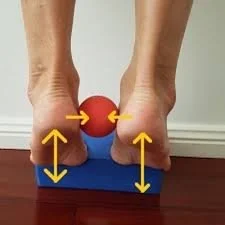
Put a “squishy” ball or towel between your heels and perform heel raises while simultaneously squeezing the ball
Focus on lifting your heels straight up and pushing through your big toes
Don’t let your heels roll out
MEDIAL
A medial knee joint center alignment is also known as a “dynamic knee valgus”; the knee dives inward toward the midline during the loading phase and midstance of the gait cycle.
Generally, a dynamic knee valgus will increase lateral loading and stress on the patellofemoral joint which can lead to “runner’s knee”.
COMMON CAUSES OF A MEDIAL KNEE JOINT CENTER ALIGNMENT:
Hip abductor (gluteus medius and/or minimus) weakness
Adductor (groin muscles) tightness
Excessive pronation of the foot
EXERCISES
Side Stepping
Start with the band around your ankles and in a small squat position
Take 20 steps to the right and then 20 steps to the left
Focus on leading with your heel. Do not let your toes turn out; this will activate the hip flexor instead of the lateral hip stabilizers (glute med and glute min) which are the target muscles of this exercise
Stay in the small squat position the whole time. Imagine you have a pencil on your forehead and “draw” a straight line as you are stepping, rather than an up-and-down line
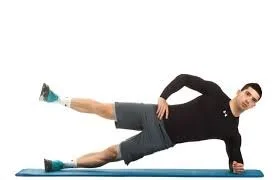
Side Plank with Top Hip Abduction
Start in a side plank position.
Focus on keeping your shoulders, hips and ankles all in a straight line → don’t let your shoulders roll forward.
Holding the position, lift and lower your top leg.
Make sure you keep your bottom hip up the whole time.
Add a band around your knees or ankles to make this more challenging
Adductor Stretch
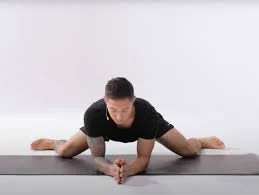
Rock back and forth to find the stretch that is deepest and works best for where your tightness is
Single Leg Stance Foot Twists
Attach a resistance band to something sturdy
Balancing on the leg that is furthest away from the secure-point and holding the resistance band securely at your midline, rotate your body away from the secure-point, and then back towards it.
Focus all of your energy on your arch; as you rotate away from the secure-point think about lifting your arch without lifting your big toe off the ground, and as you rotate back towards the secure-point think about flattening your arch.
Without changing direction, switch feet so you are now balancing on the foot that is closest to the secure point. Again, rotate your body away from the secure-point and back towards it. This time, the focus should be on flattening your arch as you rotate away from the secure-point and then lifting your arch (without lifting your big toe) as you rotate back towards the secure-point.