
KNEE SEPARATION
NARROW
A narrow knee separation during the stance phase of the gait cycle is typically caused by excessive internal rotation of the femur. This is NOT a “knee problem” but typically either a hip weakness issue or a over pronation issue at the foot. Weakness of the hip external rotators/abductors leads to internal rotation of the femur which brings the knee closer towards midline. Over pronation at the foot causes the tibia to internally rotate. This tibial IR will then lead to increased femur internal rotation and subsequent knee collapse into the midline.
COMMON CAUSES OF A NARROW KNEE SEPARATION DURING GAIT:
Excessive pronation at the foot
Weakness of the hip abductors (gluteus medius and minimus)
Tight adductors
The knee tracking excessively inward increases the stress on the patellofemoral joint and can lead to “runner’s knee, excessive strain/pull on the ITB, and excess wear and tear on the MCL.
EXERCISES
In general, you want to strengthen your hip abductors and the posterior tibialis muscles and stretch your adductor muscles to address potential weaknesses and the areas undergoing increased strain.
Heel Raise with Ball Between Heels
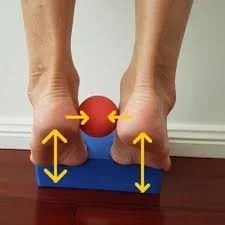
Put a “squishy” ball between your heels and perform heel raises while simultaneously squeezing the ball
Focus on lifting your heels straight up and pushing through your big toes
Don’t let your heels roll out
Side Stepping
Start with the band around your ankles and in a small squat position
Take 20 steps to the right and then 20 steps to the left
Focus on leading with your heel. Do not let your toes turn out; this will activate the hip flexor instead of the lateral hip stabilizers (glute med and glute min) which are the target muscles of this exercise
Stay in the small squat position the whole time. Imagine you have a pencil on your forehead and “draw” a straight line as you are stepping, rather than an up-and-down line
Side Plank with Top Hip Abduction
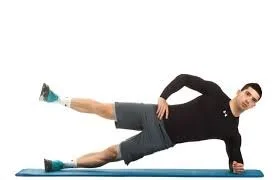
Start in a side plank position.
Focus on keeping your shoulders, hips and ankles all in a straight line → don’t let your shoulders roll forward.
Holding the position, lift and lower your top leg.
Make sure you keep your bottom hip up the whole time.
Add a band around your knees or ankles to make this more challenging
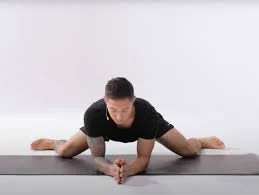
Adductor Stretch
Rock back and forth to find the stretch that is deepest and works best for where your tightness is
WIDE
A wide knee separation during gait is when the knee joint center tracks significantly lateral to the hip-to-foot axis. The runner may be subconsciously running with knees more separated to create a sturdier base of support. While creating a better base of support, this runner is loosing a significant amount of energy with this type of gait pattern.
High arches can also cause a runner to have a wide knee separation. High arches cause the tibia to remain externally rotated, as opposed to a natural pronation and internal rotation of the tibia through the gait cycle, and subsequently causing the knee to stay flared outward.
Generally, this gait pattern significantly increases the compressive load on the medial compartment of the knee which can lead to (1) medial knee arthritis, (2) strain of the lateral structures such as the IT band, and (3) general loss of efficiency in the form of lost energy laterally.
COMMON CAUSES OF A WIDE KNEE SEPARATION DURING GAIT:
High arches
Chronic ankle instability/injuries
Poor balance
The goal is to improve the “compliance” of the limb and to encourage the knee to track more neutrally toward the midline. The focus will be on strengthening the ankle evertors (Fibularis Longus and Brevis/Peroneals) and improved control of the hip.
EXERCISES
Ankle Eversion Strengthening
Put a 10 inch loop band around both of your feet and straighten your legs out in front of you.
Pull your feet apart to engage the band → the band will be “trying” to pull your feet into each other → resist this and keep your knees straight and legs apart
Holding your legs straight and apart, and using one foot as the “stable base”, turn your opposite foot in and out to work the lateral ankle muscles
Imagine you are turning your foot in to try to look at the bottom of your foot and then turn it out against the resistance
Copenhagens - Lift&Lower Leg
Start in a side plank position with your top leg bent and propped up on a chair or bench
Lift up into the full side plank position by pushing into your top knee using your adductors
Lift and lower your bottom leg up to meet the top leg and then back down
Make sure your ankle and knee are lifting and lowering at the same velocity → don’t let your knee “lead” your foot