
PELVIC TILT
TRENDELEMBERG
A Trendelenburg gait occurs when the pelvis drops on the side of the swinging leg, signaling that the hip abductors (Gluteus Medius and Minimus) on the stance leg are not strong enough to maintain a level pelvis. Instead of a stable, level stride, this "pelvic drop" causes the rest of your kinetic chain, specifically your knees and lower back, to compensate for the lack of lateral stability.
Generally, a trendelemberg gait decreases running efficiency from excessive force lost in the lateral movement rather than forward progression. In addition to decreased efficiency, the medial knee joint will undergo increased stress and the IT band will experience increased strain.
COMMON CAUSES OF A TRENDELEMBERG GAIT PATTERN:
Poor lumbopelvic control from core weakness
Weakness of the hip abductors (gluteus medius and minimus)
EXERCISES
In general, you want to work on core, gluteus medius, and medial quadricep strength to address weakness and the areas undergoing increase strain.
Standing Hip Hikes
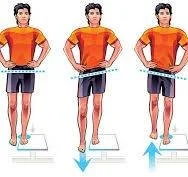
Start standing on a step/yoga block/ledge with one foot hanging off the side
Lift and lower your hip of the leg that is hanging by pulling your hip up to "crunch" your hip up to your ribcage and then lower back down
Imagine you have a pole through your leg and you are lifting straight up and down the “pole”
Side Stepping
Start with the band around your ankles and in a small squat position
Take 20 steps to the right and then 20 steps to the left
Focus on leading with your heel. Do not let your toes turn out; this will activate the hip flexor instead of the lateral hip stabilizers (glute med and glute min) which are the target muscles of this exercise
Stay in the small squat position the whole time. Imagine you have a pencil on your forehead and “draw” a straight line as you are stepping, rather than an up-and-down line
Single Leg RDL (Romanian Dead Lift)
Standing on one leg, hinge forward until your body is parallel to the ground and then stand back up
Keep your non-standing leg inline with the rest of your body; imagine your upper body and non-standing leg are a board
Don’t let the hip of your non-standing leg rotate up; keep your hips level while you hinge forward
Spanish Squats
Wrap a strong pull-up resistance band around a pole/something very sturdy and step each leg into one end; the band should be around the back side of each of your legs at the crease of your knee
Step back so that there is a LOT of tension through the band; you should step back far enough so that the band feels like it is pulling your forward and to counteract that pull, you have to lean backwards
Start from the position of leaning backwards slightly and your knees straight → your quads should be working hard to hold this position
Squat down and let your knees be pulled slightly forward as you squat down
Try to keep your back as straight up and down as possible and squat down to the point of your thighs coming parallel to the ground
Push back up into the backwards leaning position and repeat
COMPENSATED TRENDELEMBERG
With a compensated trendelemberg gait pattern, the runner’s trunk leans towards the side of the weight-bearing leg. The runner is actively shifting their center of mass over the weight-bearing hip joint to reduce the demand on the hip abductors.
Generally, a compensated trendelemberg gait pattern can lead to IT band syndrome, due to increased lateral tension placed on the structure and low back pain due to excessive lateral flexion of the lumbar spine with every step.
COMMON CAUSES OF A COMPENSATED TRENDELEMBERG GAIT PATTERN:
Hip abductor (gluteus medius and/or minimus) weakness —> causes instability of the pelvis and the runner will lean their torso over the weak hip to mechanically decrease the leverage that the hip muscles have to work against
Adductor (groin muscles) tightness —> can pull the pelvis into a medial tilt and the runner will then lean the trunk to counteract the pull and maintain balance
EXERCISES
In general, you want to work on gluteus medius and minimus strength, stretching of the groin muscles and low back muscles to address weakness and the areas undergoing increase strain.
Side Stepping
Start with the band around your ankles and in a small squat position
Take 20 steps to the right and then 20 steps to the left
Focus on leading with your heel. Do not let your toes turn out; this will activate the hip flexor instead of the lateral hip stabilizers (glute med and glute min) which are the target muscles of this exercise
Stay in the small squat position the whole time. Imagine you have a pencil on your forehead and “draw” a straight line as you are stepping, rather than an up-and-down line
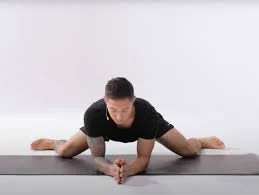
Adductor Stretch
Rock back and forth to find the stretch that is deepest and works best for where your tightness is
Child’s Pose with Side Stretch
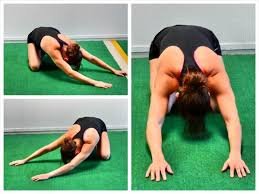
Sit back into child’s pose; stretching your hands forward and bringing your hips towards your heels.
Bring both hands to the right and hold for 30 seconds to feel and left-side-body stretch and then switch sides.