
TRUNK LEAN
LIMITED/EXTENDED
A limited or extended trunk lean is when the torso is straight vertical or tilted posteriorly at the initial contact of the gait cycle. The runner will appear to be “running tall” or leaning slightly away from the direction of travel. This will change the direction of pull of the muscles on the pelvis, increase the compression in the low back, increase the braking forces through the entire kinetic chain, and increase quadricep dominance overall. Increased quad dominance can lead to “runner’s knee”.
COMMON CAUSES OF A LIMITED OR EXTENDED TRUNK LEAN:
Overstriding —> when a runner reaches their heel far out in front of the COM, their torso will naturally stay more upright or even lean backwards to maintain overall balance
Weak hip extensors —> runners with weak glutes will stay more upright to rely more on their quads to produce power rather than the optimal power production from their glutes
Core instability —> maintaining appropriate forward lean requires enough strength in the core to counteract the backward forces being applied to it
EXERCISES
See “Heel-to-COM” page for information on cadence work.
Hip Thrusters
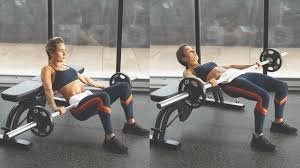
Start sitting on the ground with a bench or step behind you and a weight or barbell across your lap
Thrust your hips up by pushing through your heels and into the bench/step
Pause for 1-2 seconds at the top of the motion and then lower back down.
Bulgarian Split Squat Dead Lift
SETUP: Start sitting at the edge of a bench/box/couch. Extend one foot forward to obtain the right distance from the seat to where your foot should be placed for the exercise. Maintain the position of the foot and roll forward onto your front foot and stand up. From here, place the back foot up on the bench you were sitting on.
Lower down into the full split squat position and then hold.
From the static descended position, perform the “deadlift” by hinging forward and back to the upright position. Once you have completed the repetitions, straighten back up and then switch legs.
Single Leg RDL (Romanian Dead Lift)
Standing on one leg, hinge forward until your body is parallel to the ground and then stand back up
Keep your non-standing leg inline with the rest of your body; imagine your upper body and non-standing leg are a board
Don’t let the hip of your non-standing leg rotate up; keep your hips level while you hinge forward
FLEXED/NORMAL
A slight and consistent forward lean of approximately 5-10 degrees from the vertical is normal and optimal. This lean should originate from the ANKLES and not by purposefully hinging forward at the hips.
A slight forward lean puts the hip joint in a more advantageous position for the Gluteus Maximus to produce POWER! The “pre-stretch” that occurs on the glute max allows the muscle to drive the leg back more effectively during the propulsion phase of the gait cycle.
COMMON REASONS WHY SOMEONE HAS A NORMAL/FLEXED TRUNK LEAN:
Optimal Center of Mass positioning
Appropriate ankle mobility
Appropriate core strength